Most women can start returning to running around three months after giving birth, once their pelvic floor and core can handle impact without leaking, heaviness or pain. Your six-week clearance does not mean you are ready to run. It means you are ready to start preparing.
This is the part that catches people out. The six-week check is a medical sign-off. It confirms your body has healed enough to begin exercising again. It does not test whether your pelvic floor can absorb the impact of running, which is a very different job.
Running at a moderate pace produces landing forces of 1.6 to 2.5 times your body weight, and some of that load is likely passed to the pelvic floor with every stride. Healing also takes longer than most people assume. Research cited in the UK’s postnatal running guidelines found that six weeks after a C-section, the abdominal fascia has regained only 51% to 59% of its original strength, rising to 73% to 93% at six to seven months.
Hina Sheth, founder of Rebalance PT, puts it this way: “Being medically cleared for exercise at your six-week follow-up is different from being ready to return to running. It takes time, healing and training to come back safely without making an existing problem worse.”
A realistic timeline
Every recovery is different, but most follow a similar shape. Our guide to when to start postpartum PT covers the early weeks in more detail.
- Birth to six weeks. Walking, breathing and gentle reconnection with your pelvic floor and deep abdominal muscles. Healing comes first.
- Six weeks to three months. Assessment and rebuilding, with low-impact strength work for your legs, hips and core that progresses as your body allows.
- From three months. A gradual return to running for most women, as long as the readiness tests below feel comfortable. The UK guidelines aim for a return between three and six months after birth.
At Rebalance, we often clear patients for running at around three months, although not everyone’s recovery looks the same. A difficult delivery, a significant tear or a C-section can all move the timeline.
The readiness tests
The UK guidelines, written by physical therapists Tom Goom, Gráinne Donnelly and Emma Brockwell, suggest a set of tests to pass before running. Each one should feel comfortable, with no pain, heaviness, dragging or leaking:
- Walking for 30 minutes
- Balancing on one leg for 10 seconds
- 10 single-leg squats on each side
- Jogging in place for 1 minute
- 10 forward bounds
- 10 hops in place on each leg
- 10 single-leg “running man” movements on each side, driving the opposite arm and knee
They also suggest working toward 20 repetitions each of single-leg calf raises, single-leg bridges, single-leg sit-to-stands and side-lying leg lifts. Falling short on these is not a reason to stop. It simply shows where your training should focus.
The tests are a useful guide, but they cannot show what your pelvic floor is doing underneath. That is what an assessment is for.
What we check before you run
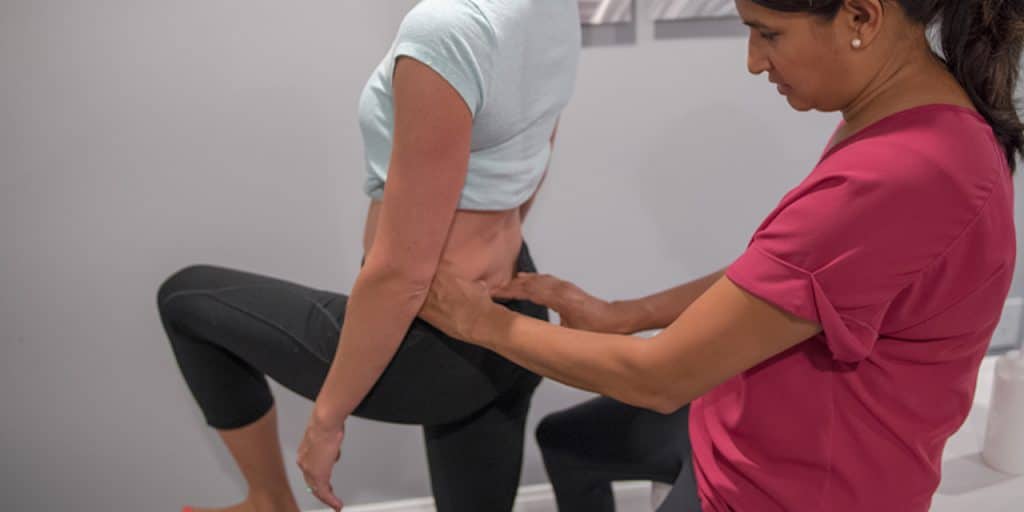
We usually see postpartum patients after their six-week checkup, once they have been cleared for exercise. We screen for weakness, tension or pain that would affect your ability to run safely, and we look at how well you coordinate your core and manage pressure when you move, cough or land. With your consent, an internal pelvic floor assessment shows us how those muscles contract and release.
From there, you get an exercise program built around your body and your running goals, whether that means a few easy miles along the Schuylkill or a full marathon.
Easing back in
Your first runs should feel almost too easy. Start with short run-walk intervals on flat ground, leave a rest day between runs, and build time on your feet before you add speed or hills. If symptoms appear, drop back a step rather than stopping altogether. Progress is rarely a straight line in the first few months, and that is normal.
Signs you are not ready yet
Stop and get assessed if you notice any of these during or after a run:
- Leaking urine, or difficulty controlling your bowels
- Heaviness, pressure or a dragging feeling in the vagina
- Pain in your pelvis, lower back or abdomen
- Doming or a visible gap along the middle of your stomach
None of these means you can never run again. They mean your body needs more support first. Heaviness in particular can be a sign of prolapse, which we cover in our guide to prolapse and running.
Running after a baby is a great goal. It just deserves a plan.
We see patients across Philadelphia and the Main Line, with clinics in Center City and Narberth. If you are getting ready to run again, postpartum physical therapy is the best place to start. Book a free 15-minute phone consultation to talk through where you are and what makes sense next.