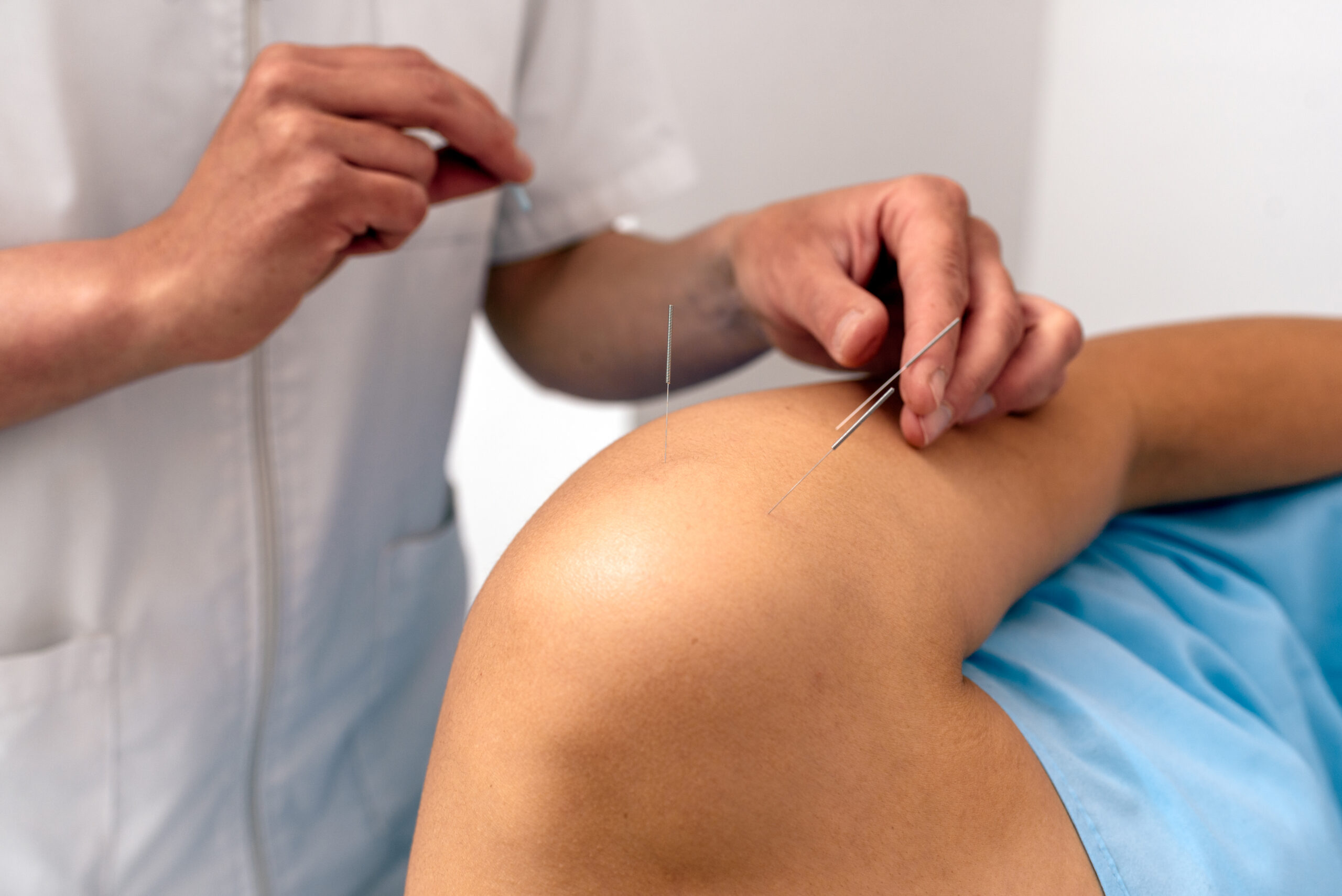
Dry needling and acupuncture both use fine sterile needles, but they are not the same treatment. Dry needling is a Western musculoskeletal intervention targeting muscle trigger points. Acupuncture is a Traditional Chinese Medicine practice working with energy meridians. Different training, different rationale, different goals.
People often assume they are the same because the needles look identical. The needles are the only thing they share. The philosophy, the technique, the training, and the conditions each treats best are all different. If you are choosing between them, the choice should be driven by what you are actually trying to fix.
The philosophy: why each one exists
Acupuncture is rooted in Traditional Chinese Medicine, with a recorded history stretching back at least 2,000 years. The framework treats the body as a system of energy pathways called meridians. When the flow of qi is blocked or imbalanced, illness or pain results. Acupuncture inserts needles at specific points along these meridians to restore flow. The practice treats the whole person and is used for everything from digestive issues to anxiety to chronic pain.
Dry needling emerged from Western musculoskeletal research in the second half of the twentieth century, particularly through the work of Janet Travell and David Simons on myofascial trigger points. The framework is anatomical, not energetic. A trigger point is a tight band within a muscle that refers pain and limits function. Dry needling targets these specific anatomical structures to release them. The goal is mechanical: restore the muscle, restore the movement, reduce the pain.
The technique: what the practitioner is actually doing
An acupuncturist works from established points mapped along the meridian system. Needles are typically inserted at shallow to moderate depth, often left in place for fifteen to thirty minutes while the patient rests. The patient may feel a dull sensation called de qi, traditionally considered a sign the treatment is working.
A physical therapist doing dry needling palpates for a specific trigger point in a specific muscle, inserts the needle directly into it, and often manipulates the needle to provoke a local twitch response. The visit can be shorter and more targeted. The patient feels a deep ache or cramp lasting one to two seconds as the muscle releases.
The same needles. Almost opposite techniques.
The training: who is doing this to you
This is where the difference matters most for safety and outcome.
Acupuncturists in the United States complete a three- to four-year master’s program in acupuncture and Oriental medicine, sit for a national board exam, and are licensed by their state. The training is rooted in TCM theory, channel and point location, herbal medicine, and patient assessment within that framework.
Physical therapists who perform dry needling have already completed a Doctorate of Physical Therapy: three years of graduate study after a bachelor’s degree, covering anatomy, neuroscience, biomechanics, manual therapy, and clinical reasoning. They then complete additional dry needling certification, typically 50 to 80 hours of post-graduate coursework with supervised practice. The American Physical Therapy Association has recognised dry needling as within the scope of physical therapy practice since the mid-2010s, and most states now license it explicitly.
The two training pathways are entirely separate. Neither is better. They are built for different jobs.
What conditions each treats best
Acupuncture has the strongest evidence base for chronic pain, migraine prevention, nausea (particularly from chemotherapy or pregnancy), fertility support, anxiety, and certain stress-related conditions. The whole-system framework lends itself well to multi-symptom presentations.
Dry needling is targeted at musculoskeletal pain driven by trigger points and tight muscle bands. The strongest evidence is for chronic neck and shoulder pain, tension headaches, low back pain, jaw pain, plantar fasciitis, tennis and golfer’s elbow, and the chronic pain patterns runners and desk workers carry around.
Hina Sheth, founder of Rebalance PT, often tells patients who ask which one is better: “Wrong question. They’re built for different goals. If your pain is muscular and mechanical, dry needling will probably get you there faster. If you want a whole-system approach to a complex symptom picture, see an acupuncturist.”
Trigger point therapy and manual therapy work together
Dry needling rarely stands alone. At Rebalance, it is part of a layered treatment that includes manual therapy on the surrounding fascia, movement retraining for whatever pattern caused the trigger point in the first place, and a short home program to keep the muscle from reverting. Releasing the trigger point without addressing what made it tight is a setup for repeat visits.
The same logic applies in reverse with acupuncture. Experienced acupuncturists almost always prescribe lifestyle adjustments, herbal support, and home practices alongside the needling. Neither tool is meant to be used in isolation.
Can you do both?
Yes. Plenty of patients see both practitioners for different reasons. Dry needling for the chronic shoulder knot, acupuncture for the perimenopausal night sweats. There is no clinical conflict, just different tools for different problems.
What you should not do is assume one is a substitute for the other. They are not.
How to choose
Ask three questions. What am I trying to fix? What approach matches the problem? Who is qualified to do the work?
If the answer to the first question is a specific muscle knot, a referred pain pattern, or a movement restriction that surface work has not touched, dry needling is the better fit. Look for a physical therapist trained in dry needling with experience in your specific area of complaint.
If the answer is a multi-system, whole-body complaint, see a licensed acupuncturist with experience in your specific area.
Both practices can be excellent. The fit between the practice and the problem is what matters.